Article
The AI Readability Score Explained
- Written by
- Jakob Kamender · Founder of Textorum
- Published
- July 10, 2026
The AI Readability Score is a diagnostic value from 0 to 100 that measures how easy a text is to read, structure, interpret, and reuse. Unlike pure syllable- and sentence-length metrics, the AI Readability Score evaluates whether a text is understandable for people and sufficiently structured for AI systems to extract its core message precisely. This article explains the four components — Sentence Clarity, Structural Organization, Entity Consistency, and Answer Readiness — and distinguishes the model from classical readability indices such as Flesch-Kincaid. You can check any English text with the AI Readability Checker to see these dimensions applied to your own writing.
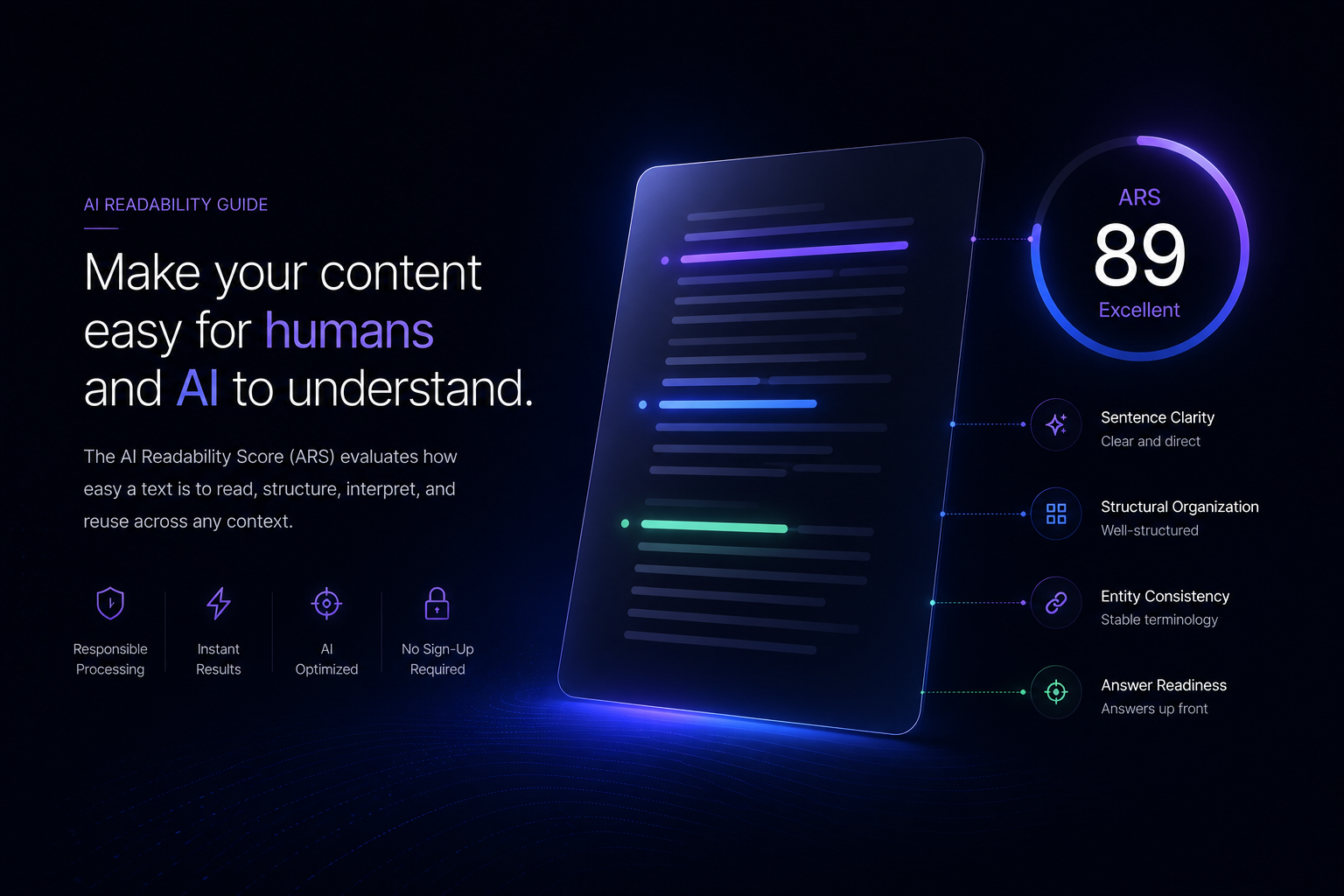
Sentence Clarity
Sentence Clarity measures how effortlessly individual sentences can be understood on first read. High clarity is characterised by direct phrasing, stable grammar, and a logical flow. Subjects and verbs appear close together; convoluted clauses and abrupt jumps are avoided. Texts with low clarity are often grammatically correct, but hide their core message behind filler words, digressions, or passive, heavily nominalised wording.
Before
After
Structural Organization
Structural Organization evaluates the logical layout and navigability of the text. Strong structure breaks topics into meaningful sections, uses descriptive headings, and keeps related ideas focused. This helps human readers scan the page and allows AI systems to match sections precisely to user questions. Weak structure appears as repetitive passages, missing transitions, or paragraphs that mix too many topics without a clear hierarchy.
Before
After
Entity Consistency
Entity Consistency checks whether key names, terms, and labels remain stable throughout the text. Constantly switching synonyms forces readers to re-interpret meaning and causes AI systems to treat identical concepts as separate entities. Strong consistency introduces terms clearly, sticks to them, and links related concepts in a way that prevents misunderstandings before they arise.
Before
After
Answer Readiness
Answer Readiness measures how quickly and directly a text answers the reader's implicit question. Grammatically correct texts often fail this metric when they delay the main point, bury conclusions in the body copy, or talk around the answer. High answer readiness means the core result comes first and can immediately be extracted as a snippet, summary, or AI answer. Context then provides the reasoning instead of making the reader search for it.
Before
After
AI Readability Score vs. Flesch-Kincaid
The Flesch-Kincaid index relies almost exclusively on mathematical factors such as sentence length and syllables per word. That's useful for estimating the purely linguistic hurdle of a text. It does not, however, say anything about whether the argument is logically structured, terms are used consistently, or the page actually answers a question.
The AI Readability Score is designed as a holistic diagnostic model. It does measure readability at sentence level, but equally evaluates semantic stability, structure, and the practical utility of the content for humans and machines. Whereas Flesch-Kincaid remains a narrow readability formula, the AI Readability Score is a tool for assessing the structural quality and semantic interpretability of content. For a full side-by-side breakdown, see AI Readability vs. Flesch Reading Ease.
AI Readability Score Ranges
The AI Readability Score returns a single 0–100 number and a letter grade. The bands below describe what each range means in practice.
| Score | Grade | What it means |
|---|---|---|
| 80–100 | Strong | Easy for humans and AI to read, segment and reuse. |
| 60–79 | Good | Broadly clear; some sections harder to extract. |
| 40–59 | Needs Work | Understandable, but structure limits reuse. |
| 0–39 | Hard to Parse | Both humans and AI systems will struggle. |
For practical recommendations on improving AI readability, read the complete AI Readability Guide.